 Miriel
Miriel Team · starting solids, choking safety, gagging, baby-led weaning, infant safety
Baby Gagging vs Choking: How to Tell
Gagging is loud, red-faced and normal; choking is silent or blue and an emergency. The signs, the memorable rule, and how to prevent it.
The one-sentence answer
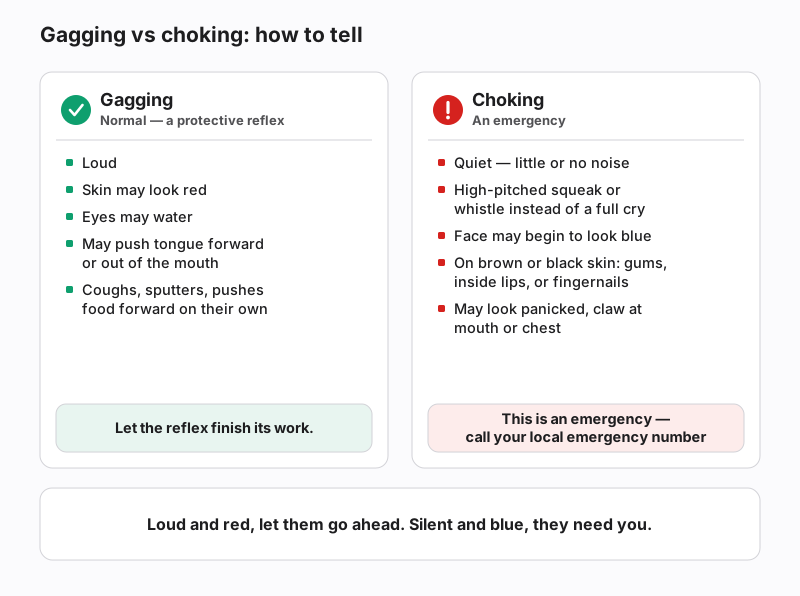
Gagging is loud, red-faced and usually harmless; choking is quiet or high-pitched, sometimes blue-tinged, and an emergency. A gagging baby is coughing, sputtering and pushing food forward on their own, which is the body doing its job. A choking baby cannot move air, so they cannot make the loud, wet noise you associate with a struggle. If you remember nothing else: loud and red, let them go ahead; silent and blue, they need you.
What gagging looks like (and why it is normal)
Gagging is a protective reflex, not a sign that something has gone wrong. The NHS describes it plainly: “Gagging is a normal reflex as your baby learns to chew and swallow solid foods.” As your baby learns to move food around the mouth, they will sometimes push it too far back before they are ready, and the gag reflex sends it forward again.
You will recognise it because gagging is noisy and dramatic. According to the NHS, a gagging baby is loud, their skin may look red, their eyes may water, and “they might push their tongue forward (or out of their mouth).” They cough, they retch, they may go a bit purple in the face from the effort, and then they clear the food and carry on. It is uncomfortable to watch. It is also how babies learn to eat safely.
The hardest part for most parents is sitting on their hands. When a baby is gagging effectively, reaching in can turn a self-solving moment into a real problem by pushing food further back. Let the reflex finish its work.
What choking looks like
Choking is the opposite of gagging in almost every way, and the biggest tell is silence. A choking baby’s airway is blocked, so air cannot pass to make sound. The NHS states it directly: “Choking is quiet.” Watch for a baby who is trying to cough or cry but producing little or no noise, a high-pitched squeak or whistle instead of a full cry, or no sound at all.
Colour is the second signal. The NHS notes that on lighter skin the face “may begin to look blue,” and on brown or black skin the blue tinge shows first in “their gums, inside their lips, or their fingernails.” A choking baby often looks panicked, may claw at their mouth or chest, and cannot draw the deep breath that gagging requires.
Here is the rule again, because it is the thing to keep in your head at the table:
Loud and red, let them go ahead. Silent and blue, they need you.
What NOT to do
If your baby is silent, blue or clearly unable to breathe, this is the moment to act and to call your local emergency number. One specific thing to avoid, whatever you have seen in films: do not sweep a finger blindly into the mouth to fish out food you cannot see. Mayo Clinic is explicit: “Never finger sweep if you can’t see the object. You risk pushing the blockage deeper into the airway.” Only remove something you can clearly see and easily reach.
This article deliberately does not teach back blows or chest thrusts, because reading steps in a panic is not how anyone should learn them. They are simple to perform and hard to improvise, which is why they belong in a hands-on class. Before your baby starts solids, take an infant first-aid or CPR course and keep a reference from the American Red Cross or the NHS saved somewhere you can find it. Muscle memory beats a search bar.
How to lower the risk in the first place
Most choking risk at mealtimes comes down to two things: how your baby is sitting, and what is on the tray.
Positioning and supervision. Both the CDC and the AAP are consistent here. Have your child sit upright while eating, never lying down, crawling or walking, and never let them eat in a moving car or stroller. Stay within arm’s reach for the whole meal. A baby who is propped at an angle, reclined, or wandering with food in their mouth is at higher risk than one seated and watched.
Food shape and texture. The CDC lists the usual high-risk offenders: uncut grapes, cherry and grape tomatoes, whole or chopped nuts and seeds, spoonfuls of nut butter, hot dogs and sausages, popcorn, hard raw vegetables and fruit like raw carrot and apple, large chunks of cheese, and hard or sticky candy and marshmallows. The AAP advises keeping these high-risk foods away from children until around 4 years of age, depending on the individual child. When you do offer risky-shaped foods, modify them: quarter grapes and cherry tomatoes lengthwise, cut round foods into small non-round pieces, spread nut butter thinly rather than serving a blob, and cook or grate hard vegetables. The CDC puts it simply: “Cutting food into smaller pieces and mashing foods can help prevent choking.” If you are still deciding when to begin, our guide on when to start solids covers the readiness signs that make early meals safer.
Does baby-led weaning cause more choking?
This is the question that keeps parents up at night, and the reassuring news is that a controlled trial has looked at it. In the BLISS study (Fangupo and colleagues, published in Pediatrics in 2016), infants following a baby-led approach that included guidance on minimising choking risk were not more likely to choke than infants who were spoon-fed. Within that studied population, the feeding style itself did not raise the choking rate.
There is an important footnote, though. The researchers found that many parents in both groups were still offering foods with a high choking risk. What matters most is not whether food arrives on a spoon or in a fist, but whether it is an age-appropriate size and shape. Safe finger foods and safe spoon foods are both safe; unsafe shapes are unsafe either way. If mealtimes are becoming a battle for other reasons, our post on what to do when your baby is refusing solids may help, and when you reach the higher-risk allergens, our step-by-step guide to introducing peanut walks through safe textures.
A note before you go
This is educational guidance drawn from published feeding and first-aid resources, not medical advice, and it cannot account for your baby’s individual history. If your child has had a feeding difficulty, a reaction, or any breathing concern, your pediatrician knows their story and should be your first call. Treat the rules here as a starting point for that conversation, not a substitute for it.
Miriel’s gagging-versus-choking safety module, like every piece of safety content in the app, is free for everyone, with the CDC, NIAID and AAP sources tappable on each screen so you can read the guideline yourself. Start with our starting solids hub.
References
- NHS. Choking and gagging on food. Best Start in Life, NHS. https://www.nhs.uk/best-start-in-life/baby/weaning/safe-weaning/choking-and-gagging-on-food/
- American Academy of Pediatrics. Choking Prevention for Babies & Children. HealthyChildren.org. https://www.healthychildren.org/English/health-issues/injuries-emergencies/Pages/Choking-Prevention.aspx
- Centers for Disease Control and Prevention. Choking Hazards. Infant and Toddler Nutrition, CDC. https://www.cdc.gov/infant-toddler-nutrition/foods-and-drinks/choking-hazards.html
- Mayo Clinic. Choking: First aid. Mayo Clinic. https://www.mayoclinic.org/first-aid/first-aid-choking/basics/art-20056637
- Fangupo LJ, Heath A-LM, Williams SM, et al. A Baby-Led Approach to Eating Solids and Risk of Choking. Pediatrics. 2016;138(4):e20160772. https://publications.aap.org/pediatrics/article-abstract/138/4/e20160772/52372/A-Baby-Led-Approach-to-Eating-Solids-and-Risk-of
- American Red Cross. Infant Choking: How To Help. American Red Cross. https://www.redcross.org/take-a-class/resources/learn-first-aid/infant-choking